
PRICING & PROCUREMENT GUIDE
What Affects the Cost of Custom Die-Cut Gaskets?
The price of a gasket is shaped by more than its outline. Material purchased, usable yield, tooling, conversion steps and the way parts are checked and delivered all appear somewhere in the quote.
THE DIRECT ANSWER
What makes a die-cut gasket expensive?
Expensive material with poor sheet yield, a new cutting die for a short run, exacting geometry, and extra converting or inspection steps. Quantity changes how those costs are spread across accepted parts. A low unit price means little if it excludes tooling, the specified adhesive or the required pack-out.
01 / READ THE QUOTE
Separate project charges from the cost of each part.
A clear quotation distinguishes the items paid once, the items repeated for every run and the items consumed by every accepted gasket. Suppliers may present these lines differently, so compare the scope as well as the total.
Tooling & setup
Cutting die, first setup, qualification and any special fixture. A drawing revision can reopen these costs.
Material & conversion
Purchased sheet area and yield, cutting, adhesive or lamination, inspection, handling and pack-out.
A die charge can appear as a separate line or be recovered through the unit price. Ask which approach is used before comparing two offers.
02 / FIND THE LEVER
Six decisions move the quote.
Each driver has a question worth answering before requesting a price. The right answer is usually on the drawing, in the application or in the purchase plan.
Material and available stock
The quote starts with a specific sheet construction, not a generic material name. Grade, thickness, hardness, width, color and required documentation determine what must be purchased. A special grade can carry a minimum batch even when the finished part count is small.
Layout and usable yield
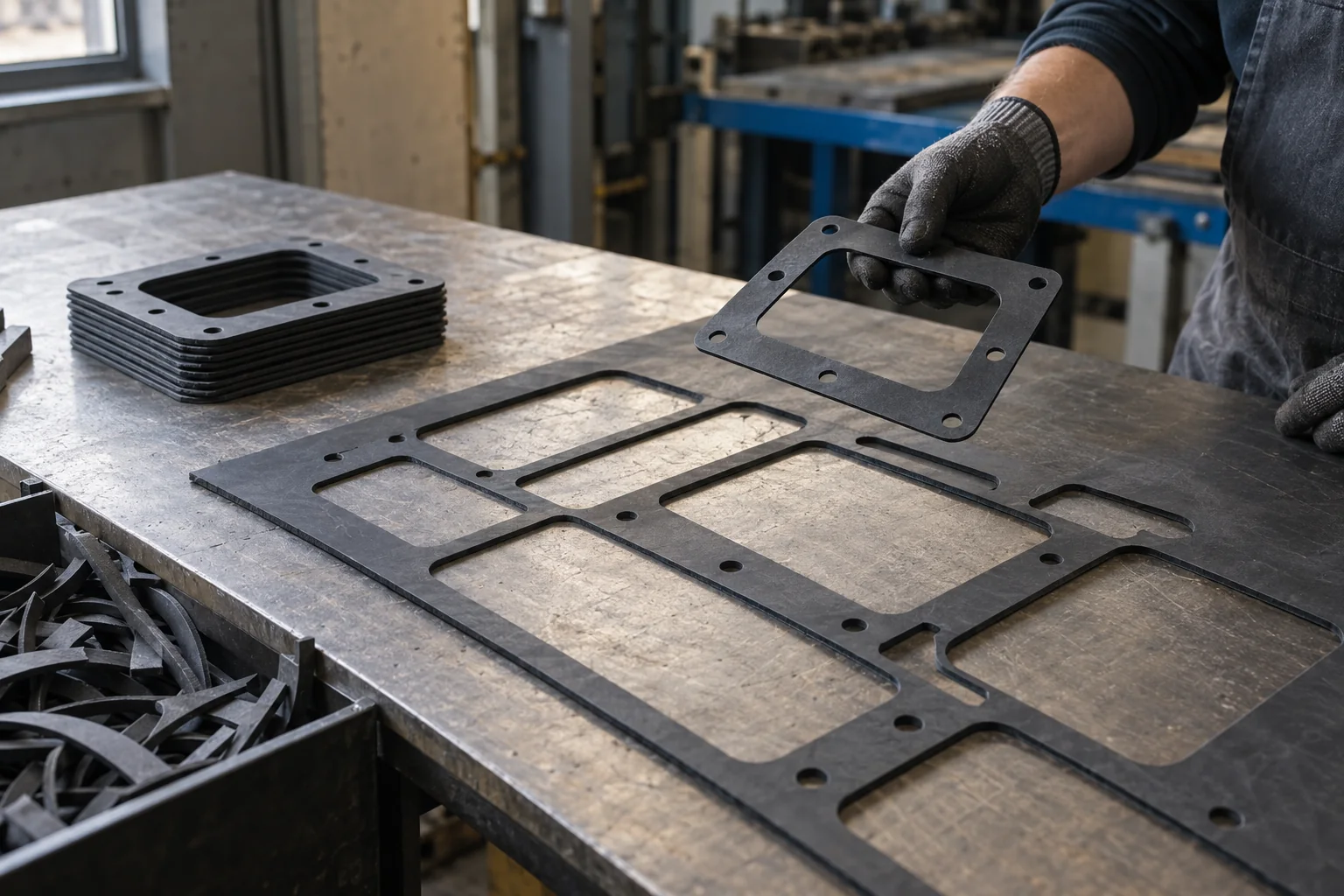
A frame gasket uses material around its opening, but the center cutout is not automatically a free by-product. The outside footprint, bridge width, part spacing and sheet width determine how many good parts fit. Offcuts only have value when another approved part can actually use them.
Cutting route and tooling
CNC knife cutting avoids a dedicated cutting die and accommodates revisions. A die adds an upfront tool and setup step, then can make a stable repeat profile more economical to run. The lower-cost route depends on total demand and the number of repeat releases, not the first order alone.
Geometry and tolerance
Small holes, narrow webs, long thin sections and tight positional requirements can slow cutting, waste removal and inspection. Tolerances should be assigned to locating holes and the sealing path where they protect fit, rather than applied indiscriminately to every edge.
Adhesive, liner and lamination
A backing request changes the material stack. The adhesive grade, coated area, release liner and delivery layout all affect purchased roll area and converting steps. A specified adhesive may need more material than the gasket count alone suggests.
Inspection and pack-out
First-article checks, dimension records, material documents, counted bags, labels and kitting take time. Define these before pricing. A loose bulk pack and a revision-controlled assembly kit are different deliverables.
THE OFTEN-MISSED DRIVER
You buy a sheet layout, not only the rubber left in the part.
A wide frame around a large opening can leave a substantial center piece. Its purchase cost does not disappear when the center is removed. A converter can test whether another approved profile fits that area, but material grade, sheet direction, handling and order timing have to line up.
For an enclosure seal, turning one continuous frame into several strips may improve yield. It also creates joints. That change belongs to the sealing design, not a cost-only edit.
Explore custom foam gasketsConcept layout — actual nesting depends on the drawing and stock size.
03 / MATCH THE ROUTE TO DEMAND
Why quantity changes the winning process
A die adds an upfront charge. A tooling-light route avoids that charge but may take more machine time for each part. The crossover arrives when the repeat-run savings have covered the tool and its setup; there is no universal piece count.
| Project | What is fixed | Likely route to compare | Cost question |
|---|---|---|---|
| Prototype or fit check | Available sheet; geometry may change | CNC knife cutting or another tooling-light route | Fast revision cycle; unit cutting cost remains visible |
| Repeat production | Approved material and stable drawing | Cutting die and optimized repeat layout | Tool cost is separated or recovered across planned volume |
| Adhesive-backed assembly part | Substrate plus adhesive and liner | Lamination, cutting and liner presentation | Roll purchase, usable area and pack-out join the base gasket cost |
04 / REDUCE COST WITHOUT LOSING THE SEAL
Six useful cost-down conversations
These choices can simplify purchasing or production while preserving the part’s job. Start with the functional requirement; then make the trade-off explicit.
Specify the job, not just the material
Send the media, temperature, compression and mating surface. An available grade can be considered only after the service requirement is clear.
Mark only the critical tolerances
Hold hole centers, sealing width and locating edges where needed. Leave nonfunctional edges under an agreed general tolerance.
Share the full demand curve
Give sample quantity, first order, likely repeat releases and annual use. A process chosen for ten samples may not be the best process for recurring batches.
Freeze the drawing before buying a die
Confirm fit and revision. A changed hole pattern or outside profile may require tool modification or replacement.
Let the layout be evaluated
State functional dimensions, then allow the converter to review sheet width, orientation and nesting. Do not reduce a sealing land merely to save material.
Price delivery format explicitly
Call out loose parts, sheets, liner-retained parts, counted bags or kits. Handling on your line belongs in the cost comparison.
Do not trade away the sealing path. Material compatibility, sufficient gasket land and the critical fit dimensions stay in the specification even when they limit nesting or require inspection.
05 / MAKE QUOTES COMPARABLE
Send one clear RFQ package.
Two prices only tell you something when they cover the same part. Include the drawing revision, application and delivery requirements, then ask each supplier to show what is included.
Mark critical drawing tolerancesInclude with the drawing
- Material grade or service conditions; nominal thickness and hardness if specified
- Flat profile, holes, cutouts, critical tolerances and drawing revision
- Prototype quantity, first order, annual use and expected release sizes
- Adhesive grade, liner, individual or sheet delivery, labels and packaging
- Inspection records, material documents and any required testing scope
Ask the quotation to show
- Tooling or setup charge and whether it is separate from unit price
- Unit prices at the quantities you may actually order
- Exact material construction, adhesive and packing scope
- Assumptions that would change price after drawing approval
PROCUREMENT QUESTIONS
What buyers ask before committing
These points expose the differences that a single unit price hides.
Does every custom die-cut gasket need a cutting die?
No. A flat gasket can be cut from suitable sheet by a tooling-light process for a prototype or changing design. A dedicated die becomes relevant when the approved profile is repeated at a volume that justifies the tool and setup.
Why is the unit price higher for a small order?
Material preparation, setup, drawing review and inspection still occur for a small batch. Those costs are spread over fewer accepted parts, and the required sheet or adhesive purchase may exceed the area used by the order.
Is the center cutout of a frame gasket counted as waste?
It is included in the purchased layout unless it can be used for another approved part with the same material specification and production controls. Reuse is a layout decision, not an automatic credit.
Will a cheaper rubber always produce a cheaper gasket?
No. The cheaper sheet may need a larger minimum purchase, cut less efficiently or fail the service requirement. Compare the complete construction and expected life, not the sheet price alone.
What should I ask for on a comparable quotation?
Ask for the exact material construction, quoted quantities, any tooling or setup charge, what inspection is included, adhesive and liner specification, pack-out and the drawing revision. Quotes with different scopes cannot be compared by unit price alone.
DRAWING-BASED MANUFACTURING
Get the full gasket cost, not a partial unit price.
Send your drawing, material and application, target quantities and delivery format. We will review the cutting route, material use and quote scope for the actual part.
- Drawing or dimensionsPDF, CAD file, sketch or a clear image
- Material and applicationShare what you know; operating conditions help
- Private drawing uploadSubmit files directly with this product inquiry
Tell us about your part
Inquiry: Custom Die-Cut Gasket
Ready for your drawing or specification file.